Model-selection study on flower images
How do a small CNN and two pretrained feature extractors compare on the same flower-image task?
University coursework
One validation split selects and scores the winner. This compares complete approaches; it is not an independent test result.
The evidence
Fig. 01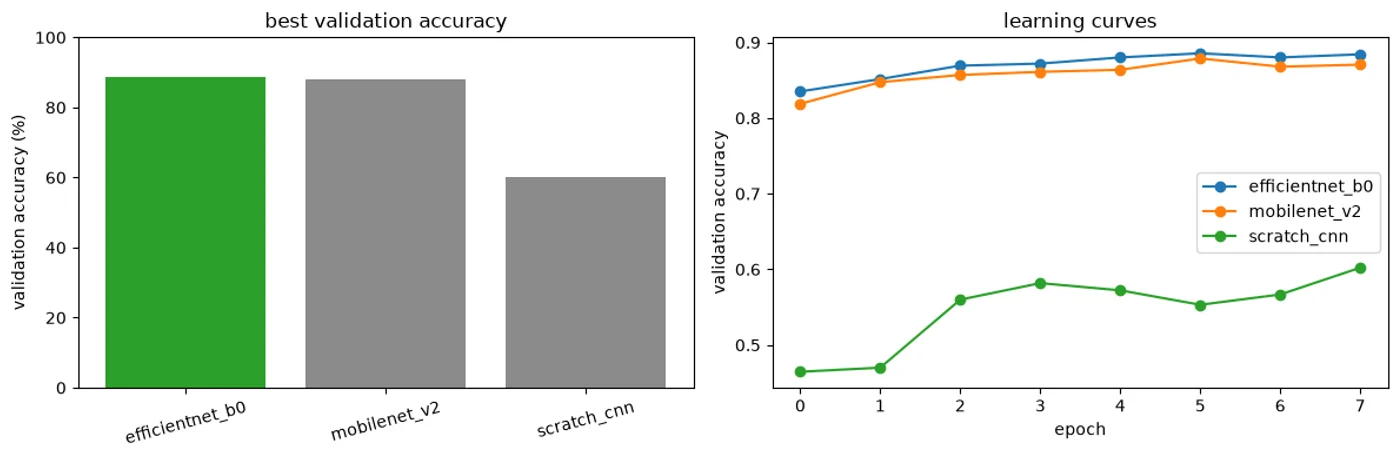
01 · Method and interpretation
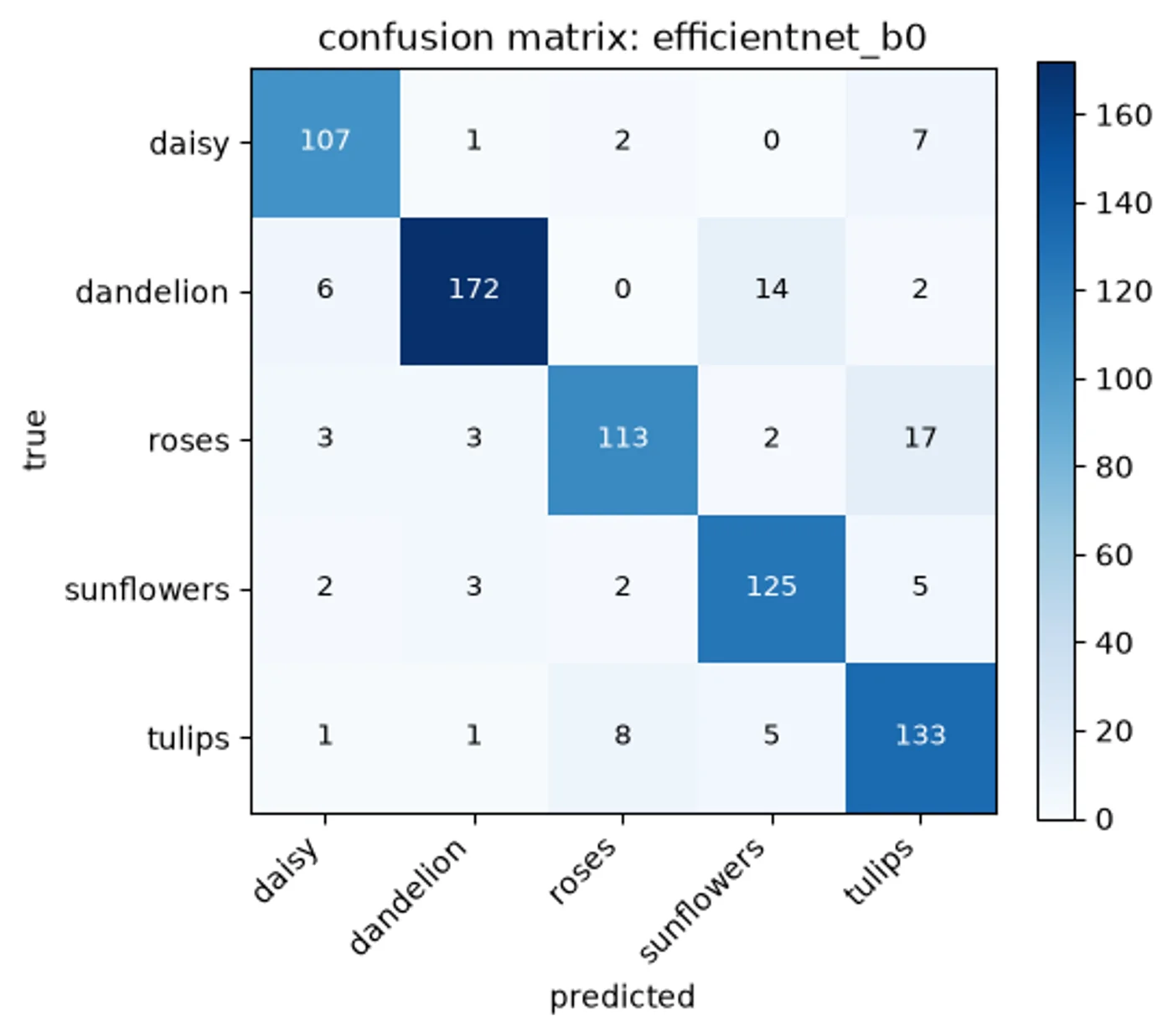
Three image classifiers share one deterministic 80/20 split, 160px inputs, augmentation, and an eight-epoch budget on 3,670 flower photos: a small CNN trained from scratch and frozen ImageNet feature extractors using MobileNetV2 and EfficientNetB0. EfficientNetB0 reaches 88.6% validation accuracy, MobileNetV2 87.9%, and the scratch CNN 60.2%. Because architecture, pretraining, and trainable capacity change together—and the same validation split selects and scores the winner—this is a practical model-selection benchmark, not a controlled architecture ablation or unbiased test estimate.
02 · Supporting figures
Selected outputs from the complete notebook.